
Comparing Canada's Combating Hate Act With the UK's Online Safety Bill
The Current Canadian Combating Hate Legislation (Bills C-9/C-63) has much in common with the 2022 UK Online Safety Bill.



David Icke is, at least according to Wikipedia, a “an English conspiracy theorist, author and a former semi-professional footballer, sports journalist and sports broadcaster,” who’s written over 20 books on a variety of topics.
Back in 2022, he wrote “The Trap: What it is. How it works. And how we escape its illusions,” an interesting book focused on the way pieces fit together and the nature of the force behind human control.
On page 111 he wrote:
People say that if you don’t like Big Tech censorship start your own platform, When you do that you have the government censors coming after you as they then target independent sites.
The UK Government’s Imran Ahmed-promoted “Online Safety” Bill is going through Parliament as I write. The Bill claims to be addressing Internet child sexual abuse, terrorist material, racial hatred and incitement to violence.
The real reason is to destroy the alternative media with crippling fines if the government’s fascist broadcast regulator Ofcom deems that the content is “harmful.”
The content can be perfectly lawful and legal, No matter - if Ofcom deems that content is harmful.
The UK Office of Communications (Ofcom), is the government-approved regulatory and competition authority for the UK’s communications industries, including TV, radio, internet, fixed-line and mobile telecoms, postal services, and wireless spectrum used by devices like cordless phones and car keys.
Its primary duty is to “protect the interests of consumers and citizens, ensuring services are reliable, safe, and fairly priced, while promoting competition among providers.”
It’s got a lot in common with the Canadian Radio-television and Telecommunications Commission (CRTC).
As of March 2026, Canada’s legislative approach to internet regulation has evolved through Bill C-63 (the Online Harms Act) and the more recent Bill C-9 (the Combatting Hate Act), which specifically targets hate propaganda and crimes.
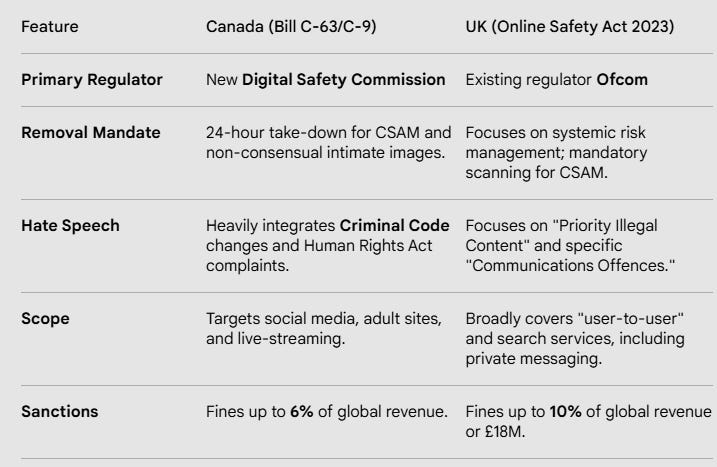
Canada’s strategy focuses on a “duty of care” model requiring substantial investment and tracking plus the implementation of “proactive measures to prevent harm,” on major social media platforms. The platforms are requiring to mitigate seven specific types of harm, including child sexual victimization, non-consensual intimate images, and a mostly undefined category of “content that foments hatred or incites violence.”
The UK version of the legislation was enforced through the existing Ofcom bureaucracy.
Canada intends to create a new “Digital Safety Commission” to enforce compliance and a “Digital Safety Ombudsperson” to advocate for users.
Bill C-9, currently under intense parliamentary debate, proposes significant amendments to the Criminal Code. It seeks to increase penalties for hate-related offenses, potentially up to life imprisonment for certain crimes, and introduces “peace bonds” to prevent hate crimes “before they occur,” by restricting access to social media in cases where a person is “likely” to commit a crime.
It also aims to remove religious exemptions from hate speech laws, a move that has sparked significant domestic controversy.
Other differences include:
How has the UKs Online Harms Act functioned in the two and a half years since being enacted into law?
At the very least the paper work needed to roll out the program was massive with hundreds of new government workers hired to implement and refine and implement the vague government directives of the original bill.
A December 2025 Ofcom report noted “significant progress” but emphasized the need for ongoing improvements.
Ofcom expects to solicit community input to better understand perceived community “gaps” in child protection. Ofcom also expects intensified enforcement, more fines, and “full categorization,” essentially the creation of additional codes to better categorize illegal content over the next year. Hopefully that doesn’t mean that Ofcom will be creating new crime for prosecution any time soon.
But what about Canada?
The Canadian legislation will likely follow down the same path with major hiring required to set up the initial departments needed to “define” the “full categorization” process required to implement the program.
Media outlet not receiving Heritage Canada funding or Canada Revenue Agency (CRA) media tax credits, or people generally not considered to be appropriate public commentators will be caught in the crossfire as will average citizens simply for saying something disliked by someone else.
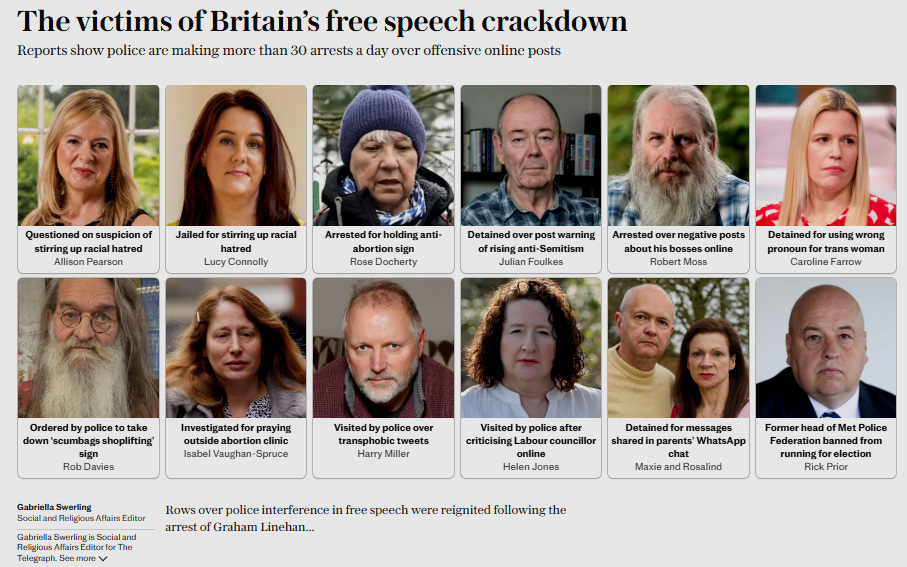
As noted in the September 3rd, 2025 The Telegraph post, “The victims of Britain’s free speech crackdown,” there were a lot of those in the first year or so after the UK legislation was enacted in the UK.
Curiously enough, since the UK Act’s enforcement focuses on regulating service providers through Ofcom, there is no official central database of individual “arrests” under this specific legislation.
Evidently, no one in the UK wants to track this sort of obvious government overreach.
Here’s hoping that the proposed Canadian legislation will be publicly tracked by Statistics Canada, through the Uniform Crime Reporting (UCR) Survey, which currently tracks all criminal code violations.
Otherwise, we’ll never know if David Icke supposition will turn out to be right in Canada.
Please support our sponsors by clicking on the images below.

